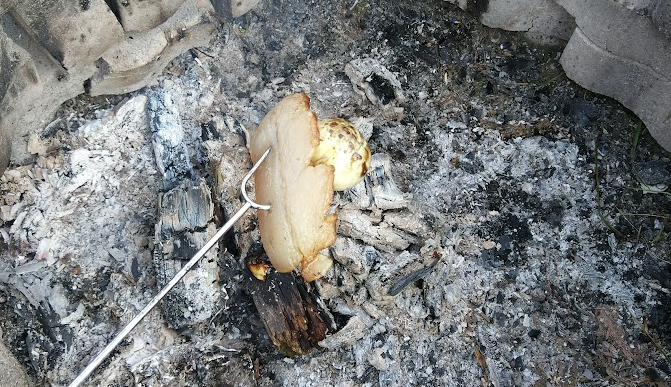
If you ever find yourself in Hungary on a warm evening, somewhere near a lake, forest, or random backyard, chances are you’ll stumble upon a group of people standing around a fire… holding sticks… slowly roasting what looks like a thick slab of bacon. Congratulations — you’ve just discovered szalonnasütés.
So what is it?
At its core, szalonnasütés means roasting bacon (szalonna) over an open fire. But calling it “just cooking bacon” is like calling a football match “just kicking a ball.” It’s a full-blown social ritual. Friends gather, firewood crackles, someone inevitably brings a guitar, and the evening slowly turns into a mix of storytelling, laughter, and slightly overcooked onions.
How does it work?
You take a chunk of cured pork fat (often with some meat attached), stick it on a skewer, and hold it above the fire. As the fat melts, it drips down onto a slice of bread below — typically topped with chopped onions, maybe paprika, peppers, or tomatoes.
Yes, you read that right: hot bacon fat dripping onto bread.
And honestly? It’s glorious.
Wait… is that even healthy?
Let’s not pretend this is a kale smoothie.
Szalonnasütés is definitely high in fat and calories, but here’s the twist: it’s not automatically worse than what many people eat daily. Traditional Hungarian bacon is often minimally processed compared to industrial spreads. That brings us to the big question…
Bacon fat vs. margarine — which is worse?
Surprisingly, the answer isn’t as obvious as you’d think.
- Szalonna (bacon fat): Natural animal fat, rich in saturated fats, but usually less processed.
- Cheap margarine: Often heavily processed, sometimes containing trans fats (depending on quality), and made from refined vegetable oils.
In moderation, many would argue that real, traditional fat is actually preferable to low-quality processed spreads. Your body at least knows what it’s dealing with.
Of course, moderation is the key word here. Eating dripping bacon fat every night? Not ideal. Enjoying it occasionally by a fire with friends? That’s a different story.
Is it disgusting?
This depends entirely on your mindset.
If you’re used to clean, neatly packaged supermarket food, the idea of fat dripping onto bread might sound… questionable. But once you try it, something clicks. The smoky flavor, the crispy edges, the warm bread soaking up all that goodness — it’s rustic, messy, and incredibly satisfying.
It’s also deeply human. Cooking over fire is about as ancient as it gets.
More than just food
Szalonnasütés isn’t really about nutrition charts or food trends. It’s about slowing down, being outdoors, and sharing something simple with others. No fancy equipment, no complicated recipes — just fire, food, and good company.
And maybe that’s why Hungarians love it so much.
Because sometimes, the best meals aren’t the healthiest or the prettiest… but the ones you remember the longest.


