So, you’ve booked your tickets to the Hungarian capital. You’ve seen the photos of the Parliament glowing like a golden palace, the massive bridges stretching across the Danube, and the hills rising over the Buda side. But as you look at the map, a tiny, nervous voice in your head asks: “Am I going to need a bionic knee replacement by day three?”
It’s a valid concern. When we travel, we often fluctuate between “Olympic athlete” energy on the first morning and “please leave me here to die on this bench” energy by the second afternoon. If you are wondering about exploring Budapest walking, you’ve come to the right place. This is a guide for people with normal human legs—not marathon runners, not mountain goats, just people who want to see beautiful things without their step-count becoming a form of torture.
The Big Comparison: How Walkable Is Budapest Compared to Its Neighbors?
Many travelers treat Central Europe like a beautiful, historical triathlon, hitting Krakow, Prague, and Budapest in one go. Naturally, we start comparing them.
If you’re coming from Poland, you might be spoiled. Krakow’s Old Town is famously compact and easy to explore on foot, where everything feels like it’s just five minutes away from a pierogi shop. It’s the ultimate “low-effort, high-reward” walking city.
Then there’s Prague. Prague’s Old Town is bigger than Krakow’s, but it’s still very manageable. Even the iconic trek across Charles Bridge and up toward the castle is the kind of walk that feels like a fairy tale, even if your calves feel a little tight by the time you reach the top.
But what about Budapest?
To be honest, Budapest is the “big brother” of the group. It is more spread out than Krakow and wider than Prague. However—and this is the important part—Budapest on foot is still very much a reality. It isn’t a sprawling concrete jungle like London or Paris where you must descend into the subway every twenty minutes. It’s a city designed for strolling; you just need to know how the distances work.
Is Budapest Actually Walkable?
The short answer is: Yes, absolutely.
The slightly longer answer is: It’s walkable, but it’s structured in layers. Unlike Krakow, where everything orbits one central square, Budapest is a collection of grand avenues and riverside promenades. While the city feels “big” because of the massive architecture, the actual distances between the major sights are surprisingly reasonable for anyone with average fitness and non-tragic footwear.
If you have a decent pair of sneakers and a willingness to stop for the occasional coffee or chimney cake, you can see 80% of the main attractions without ever stepping foot on a bus.
The “Longest” Walk You’ll Probably Do
When people look at a map of the Pest side (the flat side), they often get intimidated by the distance between City Park (Városliget) / Heroes’ Square and the Danube river area. It looks like a trek across a continent on a small screen.
In reality, this distance is around 2.5 to 3 kilometers at most. For a normal human, that’s about a 35–45 minute walk.
Here is why that isn’t a marathon:
- The Scenery Factor: You aren’t walking past industrial warehouses; you’re walking down Andrássy Avenue, a UNESCO World Heritage site. You’ll pass the Opera House, beautiful mansions, and quirky cafes.
- The Coffee Strategy: There are approximately ten billion places to sit down.
- The Flatness: Pest is as flat as a pancake. There is zero incline on this route, making it a very low-impact way of exploring Budapest walking.
Actually, walking this route usually feels shorter than it is because your brain is too busy looking at the architecture to notice that your legs are moving.
The Danube: Where Your Phone Battery Dies Before Your Legs Do
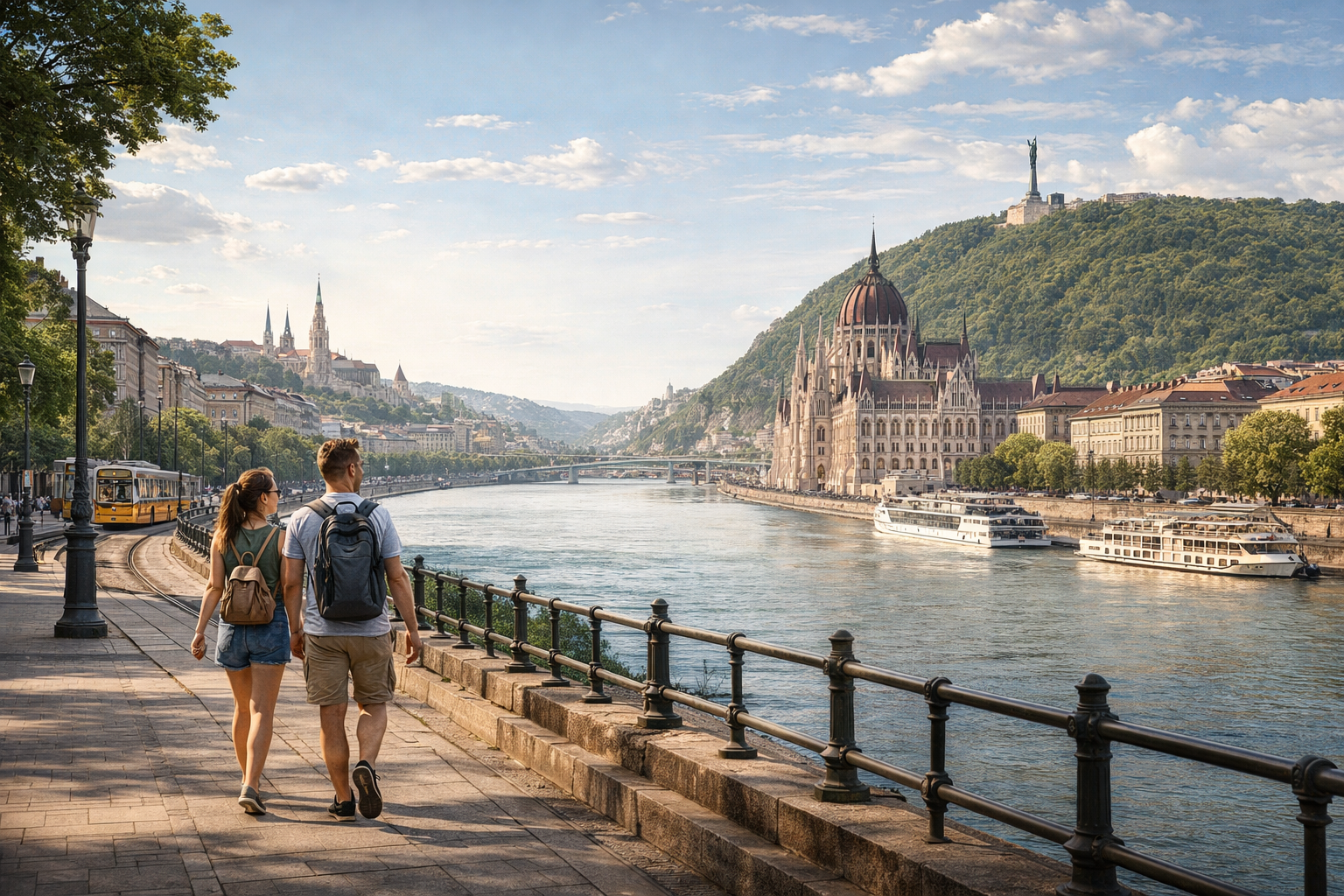
If there is one place where walkable Budapest truly shines, it’s the banks of the Danube. Walking along the river is, without exaggeration, one of the most scenic urban walks in all of Europe.
Whether you are on the Pest side looking at the Buda Castle, or on the Buda side looking at the Parliament, the views are distracting in the best way possible. You’ll wander past the Shoes on the Danube Bank memorial, stroll under the Chain Bridge, and admire the tram lines rattling past.
This is the kind of walking where you forget about the distance. You’ll look at your fitness tracker at the end of the day and realize you’ve walked 12 kilometers, but your memory only registers “pretty building, cool bridge, nice boat.”
Shopping Street Reality Check: Váci utca
Then we have the famous shopping stretch between Vörösmarty Square and the Great Market Hall (Váci utca). For a normal tourist, this is a delightful, pedestrian-only stroll. It’s easy, flat, and full of life.
However, we must add a small disclaimer for husbands, partners, or friends walking next to someone who wants to enter every single shop.
If your travel companion treats every H&M, souvenir shop, and boutique like a museum that requires a 20-minute deep dive, this 1.5 km walk will transform into a test of spiritual endurance. This is where patience and strategic snack breaks become essential. Fortunately, there are plenty of places to grab a lángos or a beer while you wait outside.
The Hills: Where Budapest Makes You Sweat
We’ve established that Pest is flat and easy. But then there’s the Buda side. This is where Budapest finally asks you to put in some effort.
Gellért Hill: The Life-Choice Questioner
Gellért Hill is the place where you will sweat. You will likely question your life choices about halfway up. You will be profoundly grateful that you didn’t wear flip-flops. It is a steep climb, and while the paths are paved, your heart rate will definitely let you know it’s working.
The Silver Lining: The view from the top is the best in the city. Period. It’s worth every heavy breath.
Castle Hill: The Gentle Giant
Don’t let the “Hill” in the name scare you off. Compared to Gellért, Castle Hill is a breeze. The paths are gradual and winding rather than straight up. Most people find that they can walk up to the Fisherman’s Bastion and the Buda Castle without needing a nap afterward. It feels much less brutal than it looks in those dramatic drone photos.
Do You Actually Need Public Transport?
In many cities, the metro is a survival tool. In Budapest, it’s more of a “comfort upgrade.”
Because the distances in Budapest are manageable, you can walk almost everywhere. You only really need the tram or the metro when:
- Your legs are genuinely tired after 15,000 steps.
- It’s raining cats and dogs.
- You want to experience the M1 (the yellow line), which is the second oldest underground in the world and incredibly cute (it feels like riding a Victorian tin toy).
The trams (especially line 2 along the river) are great, but they aren’t a necessity to get from point A to point B.
Shoes, Expectations, and Common Sense
To ensure your feet remain your friends, let’s talk logistics:
- Comfort over Fashion: Budapest has a lot of cobblestones. This is not the place to “break in” brand-new leather boots or walk 10 miles in thin ballet flats. Wear something with a bit of cushion.
- Hydrate like a Pro: As we’ve mentioned in other guides, the tap water is safe. Keep a bottle in your bag and refill it.
- The “Civilized Human” Break: Don’t try to do the whole city in one go. Budapest is famous for its cafe culture for a reason. Sit down, have a coffee, watch the people, and let your feet recover for twenty minutes every few hours.
Final Verdict: Will Budapest Destroy Your Feet?
Absolutely not. Budapest is a rewarding, gorgeous, and surprisingly accessible city. While it is more spread out than the tiny medieval centers of Krakow or Prague, the flatness of the Pest side and the sheer beauty of the Danube promenade make the distances feel like a pleasure rather than a chore.
The only place that deserves your mild respect and a bit of deep breathing is Gellért Hill. Everything else is a walk in the park—literally and figuratively.
Budapest will challenge your camera’s storage space and your phone’s battery life, but it won’t challenge your knees. Tie your laces, grab your map, and get out there. Your legs will be just fine.
Would you like me to help you plan a specific walking route that hits the best sights in under 10,000 steps?


