If you join a guided tour in Budapest, there is a good chance you will hear someone say: “Buda is hilly, Pest is flat.” It sounds like one of those travel-guide sayings that gets repeated so often that people stop questioning it.
In this case, however, the statement is largely true. It is not just a legend invented to make a tour more entertaining. If you spend a few days walking around Budapest, you will quickly notice a real difference between the two sides of the Danube.
What do you see from Gellért Hill?
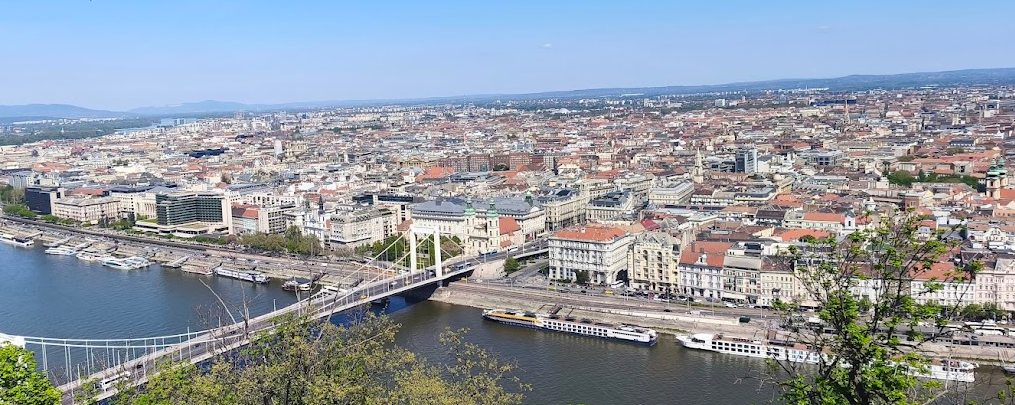
The easiest way to understand the difference is to stand on Gellért Hill and look across the river.
From the top, you are about 150 meters above the Danube. Looking toward Pest, you will see a city that stretches out across a broad plain. The streets run across mostly level ground, and there are very few noticeable hills interrupting the skyline.
When you turn around and look toward Buda, the picture changes. You see hills, ridges, elevated neighborhoods, and roads that climb and descend rather than continue in straight lines.
The contrast is easy to spot even if you know nothing about Budapest’s geography.
What does “Buda is hilly” actually mean?
Some visitors hear the word “hilly” and imagine steep mountain roads everywhere. That is not what you should expect.
Most tourist attractions in Buda are still easy to reach. Public transportation covers the area well, and many hills are relatively gentle. However, you will notice more elevation changes than on the Pest side.
Examples include:
- Gellért Hill
- Castle Hill
- The residential areas in the Buda Hills
- Several parks and viewpoints located above river level
If you enjoy walking, Buda often feels greener and less crowded. On the other hand, you may find yourself climbing stairs, walking uphill, or taking longer routes than expected.
If you plan to visit the Citadel area, it is worth reading about whether it is hard to climb Gellért Hill before you go. The climb is manageable for most people, but it can feel tiring during hot summer weather.
Is Pest really flat?
For practical sightseeing purposes, yes.
The Pest side sits on a large flat area east of the Danube. Most of the city’s busiest districts, including the areas around Parliament, St. Stephen’s Basilica, Andrássy Avenue, and the Inner City, are easy to walk around because there are few significant slopes.
This is one reason many visitors spend so much time on the Pest side. Walking between attractions is straightforward, and you rarely have to think about elevation.
If you are pushing a stroller, using a wheelchair, carrying luggage, or simply prefer easy walks, Pest generally feels more comfortable.
Does the difference matter for tourists?
Usually, yes, but not in a dramatic way.
The difference affects:
- Walking effort
- Accessibility
- Travel times on foot
- The types of views you get
- The density of buildings and neighborhoods
Pest tends to feel busier, denser, and easier to navigate on foot. Buda often feels more spacious because the hills limit how densely buildings can be packed together.
You do not need special equipment, hiking boots, or exceptional fitness to visit Buda. Comfortable walking shoes are usually enough.
So is the famous saying true?
Yes. Unlike many travel stories that become exaggerated over time, this one reflects reality.
If you stay within Budapest, it is accurate to say that Pest is flat while Buda is hilly. The difference is visible from viewpoints, noticeable when walking, and reflected in how the two sides of the city developed.
Just keep the scale in mind. Buda is not a mountain region, and Pest is not perfectly level everywhere. But for a visitor trying to understand Budapest quickly, the old saying remains a useful and realistic description of what you will experience.


