If you are standing in front of the magnificent St. Stephen’s Basilica, you aren’t just at the religious heart of Budapest—you’re in the center of its culinary universe. Within a 5-minute walk of that giant dome, you can find everything from Michelin-starred masterpieces to the best $5 pizza in Central Europe.
But with so many “tourist traps” lurking in the side streets, where should you actually spend your Forints? Here is our hand-picked guide to the 8 best spots near the Basilica for 2026.
1. The Gourmet Choice: Aszú Restaurant
If you want the “wow” factor without the stiff formality of traditional fine dining, Aszú is the place. Named after the legendary Tokaj wine, it specializes in “reimagined” Hungarian classics. It has one of the best terraces in the city for people-watching and a wine list that would make a sommelier weep with joy.
Vibe: Sophisticated, modern, and wine-focused.
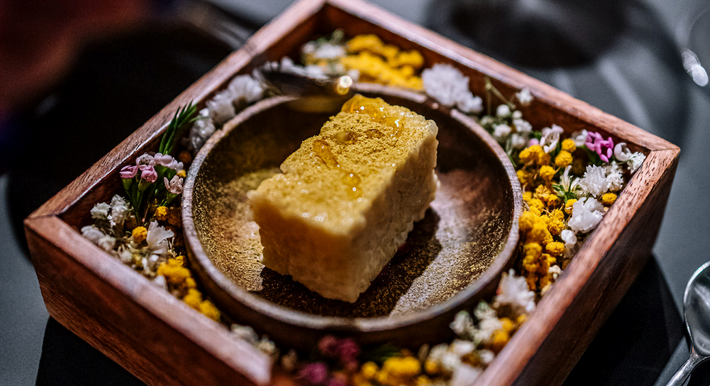
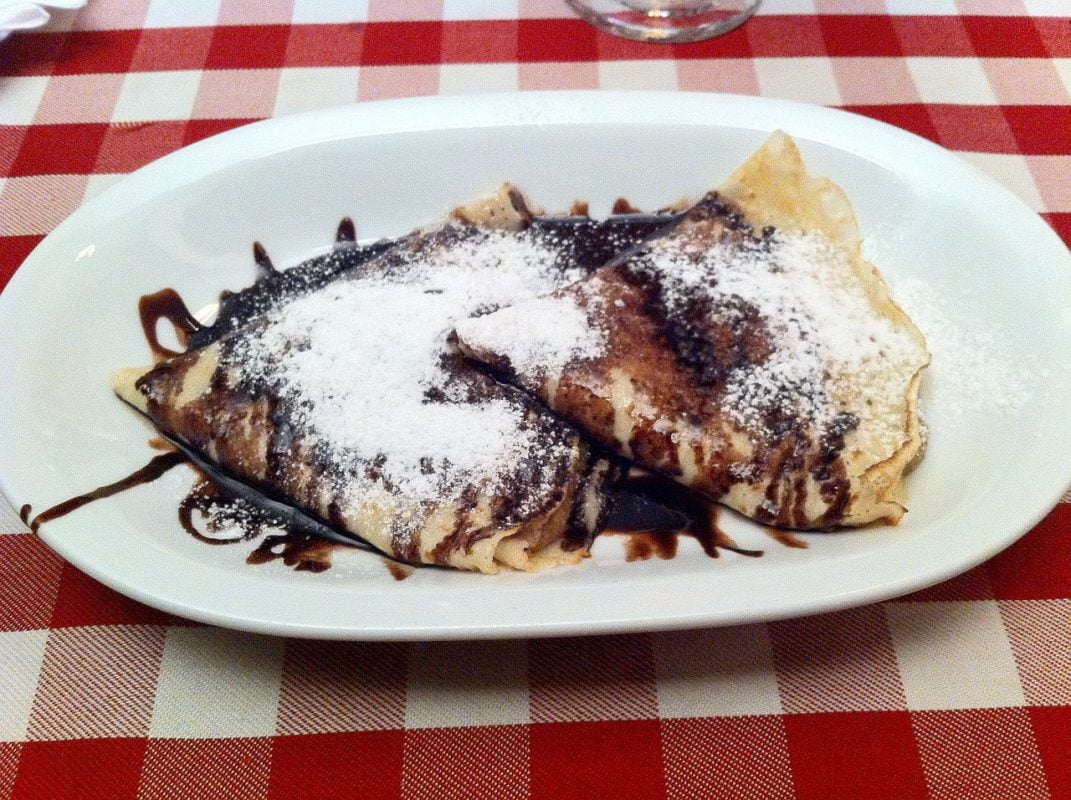
Don’t Miss: The Hortobágyi pancakes or any of their Tokaj wine pairings.
Located directly across the street from Aszú, Rézkakas is for those who want the classic, opulent Hungarian experience. Expect dark wood, impeccable service, and some of the best live cimbalom music in the city. It’s traditional luxury at its finest.
Vibe: Old-world elegance and soulful live music.
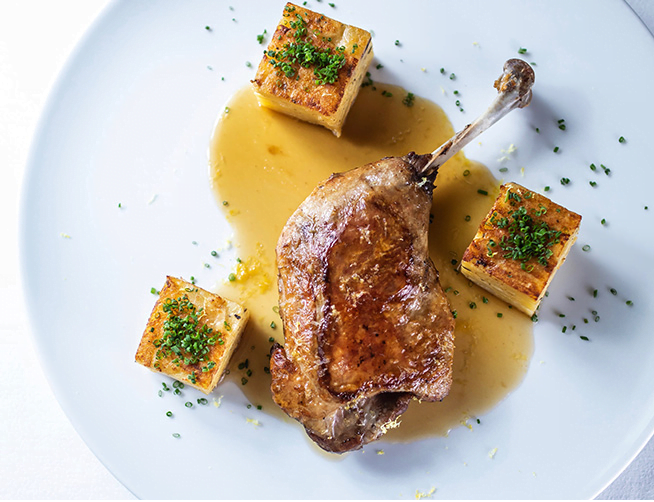
Don’t Miss: Their famous Crispy Duck Leg or the classic Goulash.
Just a few doors down from the Basilica, Borkonyha has been a staple of the Budapest food scene for years. It’s a Michelin-starred kitchen that manages to feel like a relaxed French bistro. The menu changes constantly based on the freshest ingredients available.
Vibe: High-end gastronomy in a “no-frills,” bustling atmosphere.
The Secret: It’s famous for its massive wine selection (over 100 labels!).
Founded by the same team behind Borkonyha, Textúra is located right next door. While its big brother focuses on wine, Textúra is all about—you guessed it—texture and playfulness. It features a stunning “tree” sculpture in the center and a living moss wall.
Vibe: Experimental, avant-garde, and visually stunning.
Perfect For: Foodies who want to see “science” on their plate.
5. The Italian Master: Forni di Napoli
Sometimes you just need a break from heavy paprika and cream. Forni di Napoli (on Október 6. utca) serves what many locals consider the best Neapolitan pizza in the district. Their ovens are searingly hot, and their dough is light as air.
If you’re craving spice, head to Quí on Arany János utca. It’s a contemporary Thai and Vietnamese powerhouse. The interior is dark and moody, making it one of the “coolest” spots for a late-night dinner near the Basilica.
Vibe: Trendy, exotic, and great for cocktails.
Don’t Miss: Their authentic Pad Thai or the Crispy Duck salad.
7. The “Local Secret” (Cheap Option): Kisharang Étkezde
Don’t let the tiny size fool you. This “étkezde” (traditional lunchroom) on Október 6. utca has been serving home-cooked Hungarian meals for decades. It’s one of the few places in the center where you can still get a full meal for a very low price.
Vibe: Like eating in a Hungarian grandmother’s tiny kitchen.
Price: Very Budget-Friendly.
8. The Quick Bite: Retro Lángos Budapest
You cannot visit Budapest without trying Lángos—deep-fried dough topped with garlic, sour cream, and cheese. Located just behind the Basilica at Podmaniczky Frigyes tér, this isn’t a “restaurant” in the traditional sense, but it’s a mandatory stop for any traveler.
Vibe: Standing-room-only street food.
Price: The cheapest (and most filling) bite in the area.
Planning a special evening? We highly recommend booking ahead for the popular spots like Aszú or Rézkakas, as they fill up quickly—especially during the Christmas market season and summer months. Enjoy your meal in the heart of our beautiful city!
If you have ever walked through Budapest and noticed the word Aszú on a wine list, you might have wondered: Is that a grape? A region? A secret Hungarian code word?
Let’s clear it up.
Tokaji Aszú is Hungary’s most famous wine. It is sweet, complex, historic, and once famously called the “Wine of Kings, King of Wines.” And no, that’s not just clever marketing from a modern PR agency. That title goes all the way back to Louis XIV of France, who reportedly used those exact words after tasting it.
So what exactly is Aszú, and why does it deserve such drama?
The Magic Behind Tokaji Aszú
First things first: Aszú is not just any sweet wine. It comes from the Tokaj region in northeastern Hungary, one of the world’s oldest classified wine regions (dating back to 1737).
The secret ingredient?
Noble Rot (Yes, Really)
Aszú is made from grapes affected by Botrytis cinerea, better known as noble rot. Under the right conditions—morning mist, afternoon sun—the fungus shrivels the grapes, concentrating their sugars and flavors instead of ruining them.
The result? Tiny, raisin-like berries bursting with:
Honey
Apricot
Orange peel
Caramel
Spice
And that unmistakable mineral backbone
If you want the full historical and technical background, you can read more on the official Tokaji Aszú page on Wikipedia.
What Does “Puttonyos” Mean?
When browsing a bottle of Tokaji Aszú, you will often see a number: 3, 4, 5, or 6 puttonyos.
This refers to the historical method of measuring sweetness. A puttony was a basket used to collect the noble-rotted grapes. The more baskets added to the base wine, the sweeter and richer the final result.
In modern production:
3 puttonyos → sweet, but lighter
5–6 puttonyos → intensely rich and luxurious
Today, the system has been simplified, but the terminology remains as a nod to tradition.
A Royal History
Tokaji Aszú was served in European royal courts for centuries. It was favored by:
Louis XIV of France
Russian tsars
Polish royalty
The Habsburg court
Hungary’s sweet golden treasure became a diplomatic gift and a symbol of prestige. When you sip a glass today, you’re tasting a piece of European history.
Not bad for a wine born from fungus, right?
How Should You Drink Aszú?
This is where things get interesting.
Many people assume sweet wine is only for dessert. While it pairs beautifully with:
Foie gras
Blue cheese
Fruit tarts
Crème brûlée
It can also work surprisingly well with savory Hungarian dishes, especially those featuring paprika, duck, or rich sauces. The acidity in Tokaji Aszú balances sweetness and prevents it from becoming heavy.
But here’s the thing: reading about it and tasting it are two completely different experiences.
Where to Drink Tokaji Aszú in Budapest
You can find Tokaji Aszú in many wine bars across the city. But if you really want to understand it—if you want to taste it the way it was meant to be tasted—pair it with Hungarian fine dining.
The best place to experience this wine paired with the food it was meant for is its namesake, Aszú Restaurant.
Located in the heart of Budapest, this elegant restaurant combines modern Hungarian cuisine with a serious passion for wine. Their curated selection of Tokaji wines makes it easy to explore different sweetness levels and styles without guessing your way through a wine list.
Why This Matters for Food Lovers Visiting Budapest
Budapest is not just about thermal baths and grand architecture. It’s also about flavor. And Tokaji Aszú is one of the most iconic flavors Hungary has ever produced.
Understanding Aszú gives you insight into:
Hungarian wine culture
European royal history
Traditional winemaking methods
The balance between sweetness and acidity
And when you sit down in a restaurant that carries its name, you’re not just ordering wine. You’re participating in centuries of tradition.
Beyond One Restaurant: Vineyards and Michelin-Star Experiences
While Aszú Restaurant is a fantastic place to begin your journey, Tokaji Aszú is far from a one-address experience. If you have time, consider visiting the Tokaj wine region itself, where historic vineyards such as Disznókő, Oremus, and Royal Tokaji open their cellars for tastings among rolling hills and centuries-old underground tunnels carved into volcanic rock. Closer to home, Budapest also offers several outstanding fine-dining venues where Tokaji Aszú plays a starring role on expertly curated wine lists.
Michelin-starred restaurants like Costes, Borkonyha Winekitchen, Stand, and Babel regularly feature premium Tokaji selections, pairing them with contemporary Hungarian cuisine at the highest level. Whether you sip it in a vineyard surrounded by misty hills or in an elegant dining room in the heart of the capital, Tokaji Aszú remains one of Hungary’s most unforgettable tasting experiences.
Final Thoughts
If you visit Budapest and leave without tasting Tokaji Aszú, you’ve missed something essential.
It’s not just dessert wine. It’s history in a glass. It’s craftsmanship shaped by climate and time. It’s Hungary’s golden treasure.
And if you want to experience it properly, don’t just order a random glass somewhere.
Hungary might not shout as loudly as France or Italy in the global wine conversation — but it absolutely should. This small Central European country has 22 officially recognized wine regions, a winemaking history stretching back over a thousand years, and a production volume that typically ranges between 2.5–3.5 million hectoliters per year, depending on the harvest.
From volcanic hillsides to sun-soaked plains, from bone-dry whites to legendary sweet nectar once served to kings, Hungary’s wine scene is wonderfully diverse.
If you’re visiting Hungary and want to drink like you actually mean it — not just grab a random house white — here are six wines you absolutely must taste, along with the stories behind them and where to try them.
1. Tokaji Aszú – The “Wine of Kings”
Let’s start with royalty.
Tokaji Aszú is Hungary’s most famous wine and arguably its most historic export. Produced in the Tokaj wine region in northeastern Hungary, it is made from grapes affected by noble rot (Botrytis cinerea), which concentrates sugars and flavors into intensely sweet, complex wine.
Expect flavors of:
Honey
Apricot
Orange peel
Caramel
Spice
Bright balancing acidity
This is the wine that Louis XIV reportedly called “The Wine of Kings, King of Wines.”
While visiting the Tokaj region itself is unforgettable — with its volcanic soil, rolling vineyards, and centuries-old underground cellars — you don’t need to leave Budapest to experience it properly.
One of the best places to taste Tokaji Aszú paired with modern Hungarian cuisine is Aszú Restaurant in the heart of the city. Their carefully curated Tokaj selection allows you to explore different sweetness levels and styles with expert guidance.
If you taste only one sweet wine in your life, make it this one.
2. Egri Bikavér – Bull’s Blood with a Legend
Now we head west to the Eger wine region, home of Hungary’s most famous red blend: Egri Bikavér, or “Bull’s Blood.”
The name comes from a 16th-century legend during the Ottoman siege of Eger. Hungarian soldiers supposedly drank red wine before battle, and the Turks believed they were drinking bull’s blood to gain supernatural strength.
Dramatic? Yes. Effective branding? Absolutely.
Egri Bikavér is a blend, traditionally including grapes like:
Kékfrankos
Kadarka
Cabernet Sauvignon
Merlot
Modern high-quality versions are balanced, spicy, and layered — with cherry, plum, paprika spice, and earthy notes.
Where to Taste It
In Budapest, many wine bars carry premium Egri Bikavér selections. If you want something more structured and refined, Michelin-recommended restaurants often feature elevated versions of the blend.
But if you’re visiting Eger itself, tasting it in a traditional cellar in the Szépasszony Valley is a must.
3. Furmint – The Dry Face of Tokaj
Most people associate Tokaj with sweet wine, but Furmint (the main grape behind Tokaji Aszú) also produces stunning dry wines.
Dry Furmint is:
Crisp
Mineral-driven
High in acidity
Often compared to Riesling or Chablis
Thanks to Tokaj’s volcanic soil, it often carries a flinty, smoky edge that makes it incredibly food-friendly.
Where to Taste It
Again, Tokaj is the obvious destination — but in Budapest, restaurants specializing in Hungarian wine will almost always offer at least one dry Furmint by the glass.
At Aszú Restaurant, you can often compare dry and sweet Tokaj styles side-by-side — a fantastic way to understand the grape’s versatility.
4. Juhfark – The “Wedding Night Wine”
Now for something truly Hungarian.
Juhfark, which literally means “sheep’s tail” (named after the elongated grape cluster shape), is native to the tiny Somló wine region, one of Hungary’s smallest and most unique volcanic areas.
Historically, Juhfark was believed to increase the chances of conceiving a male heir. Habsburg rulers reportedly drank it on their wedding nights.
Superstition aside, Juhfark produces:
High-acid
Structured
Mineral-heavy wines
With smoky, salty undertones
It’s not flashy. It’s serious. It’s distinctive.
Where to Taste It
Somló is worth visiting if you love niche wine experiences. But in Budapest, specialty wine bars focusing on Hungarian indigenous grapes are your best bet.
Ask for it specifically — this is not a mainstream export wine.
5. Kékfrankos – Hungary’s Red Workhorse
Known internationally as Blaufränkisch, Kékfrankos is arguably Hungary’s most important red grape.
It thrives especially in:
Sopron
Villány
Eger
Kékfrankos wines are typically:
Medium-bodied
Bright in acidity
Red-fruited (cherry, raspberry)
Spicy and elegant
In cooler regions, it can resemble Pinot Noir in structure. In warmer regions like Villány, it becomes darker and more powerful.
Where to Taste It
Villány is famous for bold reds, but you’ll find excellent Kékfrankos in Budapest’s wine-focused restaurants and bistros.
If you enjoy balanced European reds that pair well with food, this is your grape.
6. Kadarka – Hungary’s Comeback Kid
Once nearly extinct, Kadarka has made a strong comeback in recent decades.
Historically used in Bikavér blends, it is now increasingly bottled as a single-varietal wine.
Kadarka is:
Light-bodied
Spicy
Floral
Bright and fresh
Think elegance over power.
Where to Taste It
Eger and Szekszárd are strongholds for quality Kadarka. In Budapest, look for modern producers who treat it seriously — it’s no longer just a blending grape.
A Quick Overview of Hungary’s Wine Regions
Hungary has 22 wine regions, grouped into larger wine districts, including:
Tokaj
Eger
Villány
Sopron
Balaton
Somló
Szekszárd
Each region has distinct soil types — from volcanic rock in Tokaj and Somló to limestone and loess in southern Hungary.
Hungarian winemaking dates back to Roman times, and today the country produces millions of hectoliters annually, with a growing focus on quality over mass production.
The modern Hungarian wine scene is a mix of:
Ancient indigenous grapes
International varieties
Boutique family wineries
Michelin-starred restaurant pairings
Final Thoughts
If you come to Hungary and only drink generic “house white,” you are missing the entire point.
Taste:
The royal sweetness of Tokaji Aszú
The legendary strength of Egri Bikavér
The volcanic edge of Juhfark
The elegance of Kékfrankos
The revival story of Kadarka
The dry precision of Furmint
Hungary may be small on the map — but in the wine world, it’s anything but small in character.
If you’ve spent more than twelve minutes in the center of Budapest, you’ve likely found yourself wandering down Sas utca. It’s that charming, pedestrianized street leading away from the grand St. Stephen’s Basilica. It is also, quite literally, the “Gourmet Gauntlet” of Budapest.
On one side of the street, you have the sleek, wine-focused Aszú Restaurant. On the other side, practically staring it in the face, you have the legendary Rézkakas Bistro.
For a hungry tourist, this is the ultimate “first-world problem.” It’s like being forced to choose between a vintage Ferrari and a brand-new Lamborghini—both are going to get you where you’re going in style, and both are going to make your wallet significantly lighter.
So, how do you choose? Having “sacrificed” my waistline to test both, here is the ultimate breakdown of the Sas utca rivalry.
The Vibe: Tradition vs. Modern Elegance
Let’s start with the atmosphere. Both restaurants are “high-class,” meaning this is the place to wear that nice shirt you packed, not your “I ❤️ BUDA-F**KING-PEST” tank top.
Rézkakas feels like a warm, wood-paneled hug. It’s a bistro in the grandest sense of the word. It’s slightly more “Old World.” When you walk in, you feel like a 19th-century Hungarian count who is about to discuss politics over a heavy plate of venison. It’s intimate, prestigious, and deeply rooted in tradition.
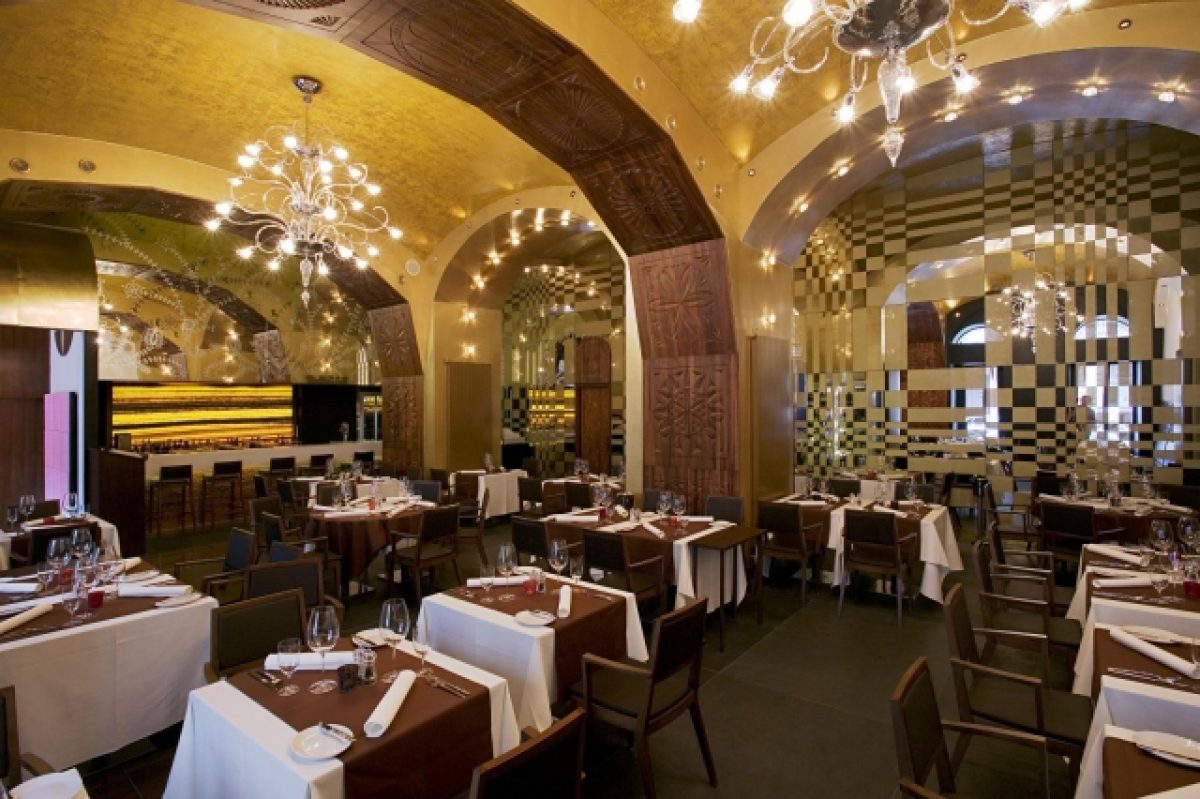
Aszú, on the other hand, is the cooler, slightly more sophisticated younger sibling. The interior is stunning—featuring an incredible ceiling that looks like a swirl of wine or honey—and the lighting is designed to make everyone look about 15% more attractive. It’s “Gourmet Modern.” It’s the kind of place where you take a date if you’re planning to propose, or where you go to celebrate a deal that actually went through.
The Music Factor
Now, here is a secret: you’re going to hear the soulful strings of a violin at both. Both restaurants feature live Gypsy music (traditional Hungarian folk music).
At Rézkakas, the musicians are legendary, often featuring a cimbalom (that big hammer-dulcimer thing that sounds like a piano on caffeine).
At Aszú, the music is equally professional but often feels a bit more like a background soundtrack to your wine swirling, whereas at Rézkakas, the music is often the heart of the room.
The Battle of the Terrace: Why Season Matters
If you are visiting Budapest between April and October, the game changes completely.
Aszú has the undisputed “Terrace Advantage.” While both restaurants have outdoor seating, Aszú’s terrace is much larger and more expansive. Sitting outside on Sas utca at Aszú on a warm May evening is peak Budapest. You get to people-watch the tourists walking toward the Basilica while you enjoy a chilled glass of dry Furmint.
Rézkakas has outdoor seating too, but it’s a bit more “cozy” (read: smaller). If you suffer from claustrophobia or just like a lot of elbow room for your Goulash, Aszú’s outdoor setup wins the round.
The Food: Reimagined vs. Refined
You aren’t going to get a “bad” meal at either place. You are more likely to find a unicorn in the Danube than a bad Paprikash on Sas utca. However, the approach is different.
At Rézkakas, the food is “Refined Traditional.” Think of the best meal a Hungarian grandmother ever made, then give her a Michelin-star kitchen and a staff of twenty. The portions are generous, the sauces are rich, and the flavors are bold. Their Crispy Duck Leg is the stuff of local legend.
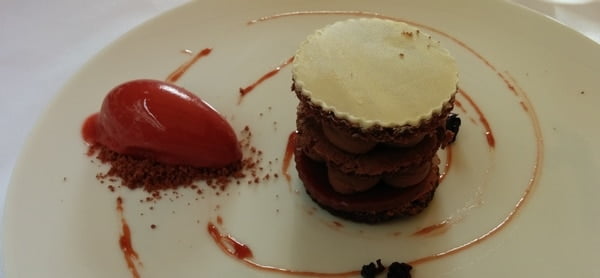
At Aszú, the keyword is “Reimagined.” They take the same Hungarian DNA but play with textures and presentations. You might get a Goulash that is served in a way you’ve never seen before, or a dessert that looks more like a piece of modern art than a cake. It’s lighter, more experimental, and very focused on how the food interacts with—you guessed it—wine.
Let’s Talk Wine: The “Aszú” Factor
It’s in the name. Aszú is named after the world-famous sweet dessert wine from the Tokaj region. Consequently, their wine cellar is a temple to the grape. If you are a wine aficionado, Aszú is your heaven. Their sommelier doesn’t just pour wine; they tell stories. They have a massive selection of dry whites (Furmint, Hárslevelű) and, of course, the liquid gold that is the Aszú dessert wine.
Rézkakas has an excellent wine list as well, featuring the heavy-hitter reds from Villány and Eger. But if we are talking about a specific “wine experience” where the bottle is as important as the steak, Aszú takes the trophy by a hair.
The Price: Checking Your Bank Balance
Let’s be real: neither of these is a “budget” choice. If you want a $5 meal, there’s a gyros shop around the corner that will serve you something questionable in a pita.
On Sas utca, you are paying for quality, service, and the “Prime Real Estate” tax.
Aszú: Expect main courses to sit between 8,000 and 14,000 HUF ($22 – $40 USD).
Rézkakas: Prices are very similar, perhaps leaning slightly more toward the upper end for certain game meats and specialty steaks.
For a full three-course meal with wine and coffee for two people, you should budget around 45,000 – 60,000 HUF ($130 – $170 USD) at either establishment. It’s an investment in your happiness.
What do the Reviews Say?
If you spend an hour on Tripadvisor, you’ll see a pattern:
Aszú Reviews: “The best wine pairing of my life,” “Stunning decor,” and “The outdoor terrace is perfect for a summer night.” The occasional complaint? “It felt a bit too fancy for my kids.” (Pro tip: Aszú is definitely a ‘date night’ or ‘grown-up dinner’ spot).
Rézkakas Reviews: “The music was incredible,” “Best Goulash in the city,” and “The service made me feel like royalty.” The occasional complaint? “It’s very popular and can feel a bit crowded during peak hours.”
The “Why Not Both?” Solution
If you are in Budapest for more than two nights, here is my personal advice: Try both.
They are located so close to each other that you can literally stand in the middle of the street and see into both windows. They represent two different sides of the Hungarian soul—one that looks back at a glorious, opulent past (Rézkakas) and one that looks forward to a sophisticated, gourmet future (Aszú).
Eat at Aszú Restaurant on your first night to toast your arrival with a glass of Tokaj. Then, on your final night, head to Rézkakas for a grand, musical finale to your Hungarian adventure.
Final Tip: Both of these places are extremely popular. If you show up at 7:00 PM on a Friday without a reservation, the only thing you’ll be eating is your disappointment. Luckily, we can help you with that! Whether you want the wine-centric elegance of Aszú or the traditional soul of Rézkakas, make sure to book your table in advance through our links—it’s free and ensures your spot in the heart of Budapest.
So, are you Team Aszú or Team Rézkakas? Honestly, in this battle, the only real winner is your stomach.
It is warm outside, the sun is shining, and you are exploring the city of Budapest in shorts and a T-shirt. Now you would like to grab something to eat, but sitting inside feels like hypocrisy with the beautiful weather outside. Where can you go in Budapest to enjoy a nice cup of coffee, a delicious dinner, or a quick snack while enjoying a stunning view or a quiet street? There are lots of options, and you will probably succeed in your mission even without this article. But, we have still written this article to help you find a somewhere to eat and drink outdoors in Budapest.
Budapest’s weather brings joy to outdoor enthusiasts, and the warm evenings arrive already in March and April. If you are lucky, you can sit outside and eat your dinner until late November. This delightful climate sets the stage for a long season of outdoor eating, inviting both locals and tourists to relish the outdoors while indulging in delectable meals. Of course, you might be unlucky and experience terrible weather with rain and wind in this period, but if you are lucky, you can sit outside and eat fantastic food from March until November.
But, where should you go? We will come up with some concrete suggestions, but also give you some general suggestions and ideas.
General tips about eating outdoors in Budapest.
It isn’t difficult to find a place where you can eat and drink outdoors in Budapest. It is very normal for restaurants and cafés to have tables outdoors, so you can mostly find this wherever you go.
There are certain areas in which you will find it much more concentrated, and here I will share some popular areas with you.
Váci utca – the pedestrian street of Budapest.
There are many restaurants in Budapest’s main shopping street with chairs and tables outside. The closer you get to Vörösmarty Square, the better they get, and you will find even more at the square itself. There are several Italian and Hungarian restaurants in this area, and you might be surprised to discover that these restaurants aren’t much more expensive than restaurants elsewhere in Budapest.
Liszt Ferenc tér – the square named after the most famous Hungarian composer.
This is a fantastic square for dining outdoors, and if is packed with restaurants, bars, and cafés. Honestly, this is probably the best area for dining in a peaceful environment in Budapest, at a square without car traffic, and you are only surrounded by hundreds of others at the square eating and drinking together with you.
The restaurants at the square have all sorts of profiles and the quality they serve is very good. In other words, the restaurants you will find at this square should be suitable for an evening with friends, or with colleagues and future business partners.
Ráday utca – a popular street among locals and tourists.
Starting from Kalvin tér, the Ráday utca is popular for dining and drinking. It has restaurants located next to one another, and you will find restaurants mentioned by the Michelin guide, fast food restaurants, great places for pizza, bakeries, and whatever you might look for in this street.
Some people complain that there is car traffic in the street, meaning that you might be disturbed by the traffic passing by (it is a one-way road). If you don’t mind some cars making noise, then this is a perfect place to go for a good dinner while enjoying a fantastic spring/summer/autumn evening in Budapest.
Bonus: Along the Danube – dining outside with a spectacular panorama.
One should not forget about the Danube, the river that makes Budapest so special and beautiful. There are lots of restaurants along the Danube, and two of the premium locations for dining is the area close to the Szabadság híd (as you walk towards the Petöfi híd). This area is undiscovered by most tourists, but it gives a spectacular view while enjoying premium bites of food.
The more typical area to dine is next to the Danube Princess, the statue located at the Vigadó square. Here you will find several restaurants, and this location is only 150 meters from Vörösmarty Square, the popular square at the end of the pedestrian street of Budapest. The most famous restaurant here is Corso, a place known for delicious Hungarian food accompanied by Hungarian gypsy music.
Cut the trap – Where can I eat outdoors in Budapest?
We have given you lots of useful information already, but are you looking for concrete names and suggestions? Here you go.
Corsó – Apáczai Csere János u. 12-14
We mentioned this earlier in the article, but it is a great option if you want a very traditional Hungarian meal with a stunning view of the Danube. The profile of the restaurant is outdoor seating, meaning that this restaurant is available with seating outdoors throughout the year (almost). It might be a bit touristic, and if you don’t want musicians playing the typical gypsy music close up all evening, you might want to find a seat as far away from them as possible (they will most likely come and play by your table once anyway).
Aszú & Rézkakas – Sas utca
These restaurants are located opposite one another in the popular Sas utca. This street has restaurants with Michelin stars, and even though Aszú and Rézkaks don’t have Michelin stars, they are still great for fantastic dinners while enjoying the fresh air of Budapest. The outdoor area of Aszú is bigger and better than that of Rézkakas, so if you want to make sure to get a good table outside, Aszú is a better option.
Both restaurants have a very traditional Hungarian profile with the best dishes from Hungary, traditional Hungarian music, and tasty Hungarian wine. It isn’t a coincidence that the restaurant Aszú has received its name from the most famous of all wines produced in Hungary.
The most famous confectionery in Budapest is located at the Vörösmarty tér, and it’s named Gerbeaud. Gerbeaud has been around since 1858 and people love it for its yummy cakes and pastries. Inside, it has kept the atmosphere of a traditional confectionery, and the place is especially known for cakes such as the Dobos cake and Gerbeaud cake.
Gerbeaud has a large outdoor area in which you can eat and drink, making it a perfect way to relax and enjoy something after a long day with shopping or just as a place for a coffee break in the middle of the day before you get at exploring Budapest once again.
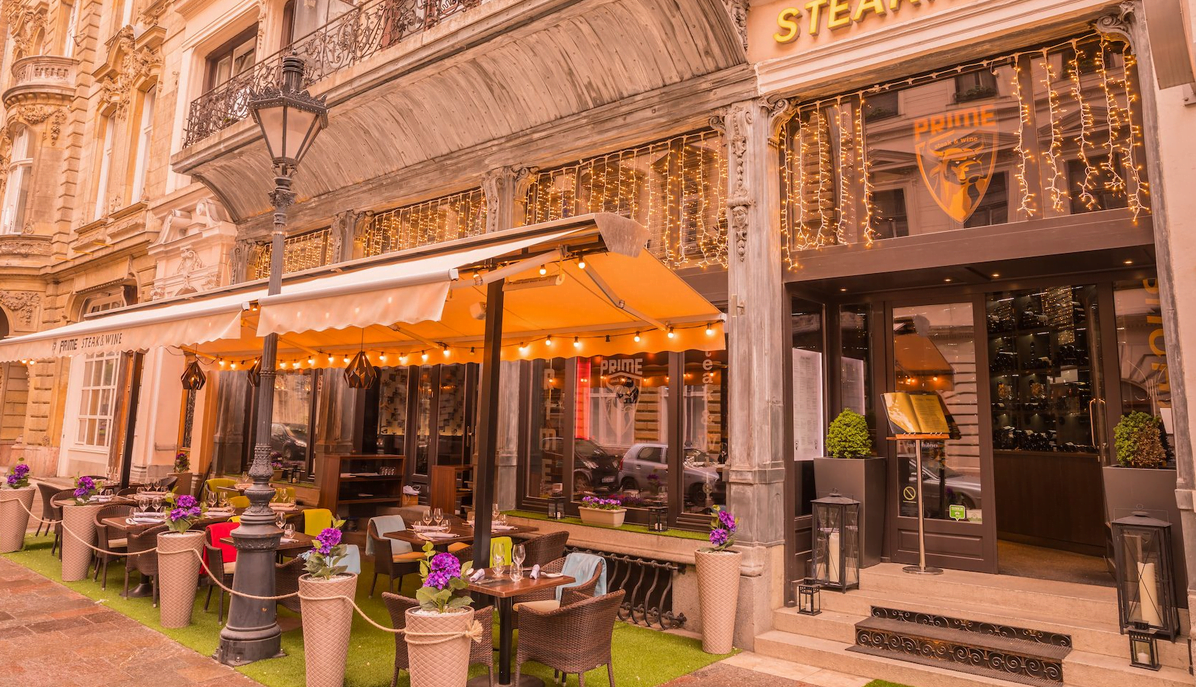
Prime Steakhouse – Sas utca.
Would you like to eat something else than a Hungarian wiener schnitzel, or an Italian pizza? Do you feel the water in your mouth if you think about a juicy 300g steak? There are lots of steakhouses in Budapest, but few of them have outdoor seating. Prime Steakhouse in Sas utca is first of all an indoor steak restaurant, but they have 4-6 tables outdoors at which groups can sit down and eat. Of course, it is very important to book a table if you want to ensure that you get to sit and eat outside during a busy evening, but you might also be lucky if you are just walking by.
It is possible to eat delightful steaks outdoors at Prime Steakhouse in Budapest.
Prime Steakhouse isn’t only one of few steakhouses in Budapest with outdoor seating… it is a very good place for steaks. The restaurant also has a cool way of presenting their desserts, meaning that they have models of all the desserts available in the restaurants. As a result, you can decide what to eat for desert based on what they will look like on the plate. Isn’t that cool?
We have now given you basic information about dining outdoors in Budapest and suggestions for areas where you can find lots of great restaurants. If you have read through the entire article, you also know that there are lots of restaurants all across the city where you can eat outside, so there is no need to worry.
If you have any further questions, or maybe suggestions and input that you would like to share, use the comment field below. We look forward to hearing from you!
Hungarian food is well-known worldwide. It might not compete with the fame of the Italian, Mexican, French, and Indian kitchens, but it is still widely known and famous. So it is no wonder there are Hungarian restaurants located in big cities all around the world. But you expect the best Hungarian food to be served in Hungary and the country’s capital, Budapest. So where should you go to eat the best Goulash soup and other traditional Hungarian dishes as you come to Budapest? This article will tell you about several restaurants worth considering!
We will not only tell you about some of the best places for a traditional Hungarian dinner in Budapest. That is the article’s main focus, but if you keep reading until the end, you will also find recommendations for what to order as you visit the different restaurants. Hungarian Goulash soup is the most famous course, without a doubt, but it doesn’t mean that you should eat Goulash three times a day during your stay in Budapest. Fantastic meals are waiting for you, and we share information about different meals worth tasting at the end of this article.
11 Restaurants in Budapest for those who want to eat a traditional Hungarian meal.
A traditional Hungarian restaurant normally serves you a giant portion of food on a big plate. At least, that was the way it used to be. However, times and the culinary picture of restaurants in Budapest are changing. Instead of giant portions, restaurants are moving toward fine dining. The large plates are still there, but the portions are smaller, and the prices are higher. Luckily, it tastes amazing and looks fantastic. Let’s get started!
Traditional Hungarian restaurants with Gypsy music.
The so-called Gypsy music is trendy in Hungary and an essential part of the culture. The musicians are incredibly talented, meaning you can get a nice musical experience accompanying your food if you visit such a restaurant. In some of these restaurants, the musicians offer to play a song of your choice by the table during the evening, but you can say no if you don’t want that to happen.
Gundel
Gundel might be the most famous restaurant in Budapest. It is located in the beautiful City Park, next to popular activities such as the Zoo, the Circus, and the Szechenyi thermal bath. This restaurant has served celebrities and royalties for over a decade, and it is where you can feel like a royal if you decide to dine there. Gundel is one of few restaurants in Budapest with a dress code, meaning that you should dress up if you choose to eat your dinner in the restaurant.
Gundel renewed their menu recently, meaning that it is now all about traditional Hungarian courses in a modern way. As a result, this might be one of Budapest’s best places to taste the best Hungarian food in royal surroundings.
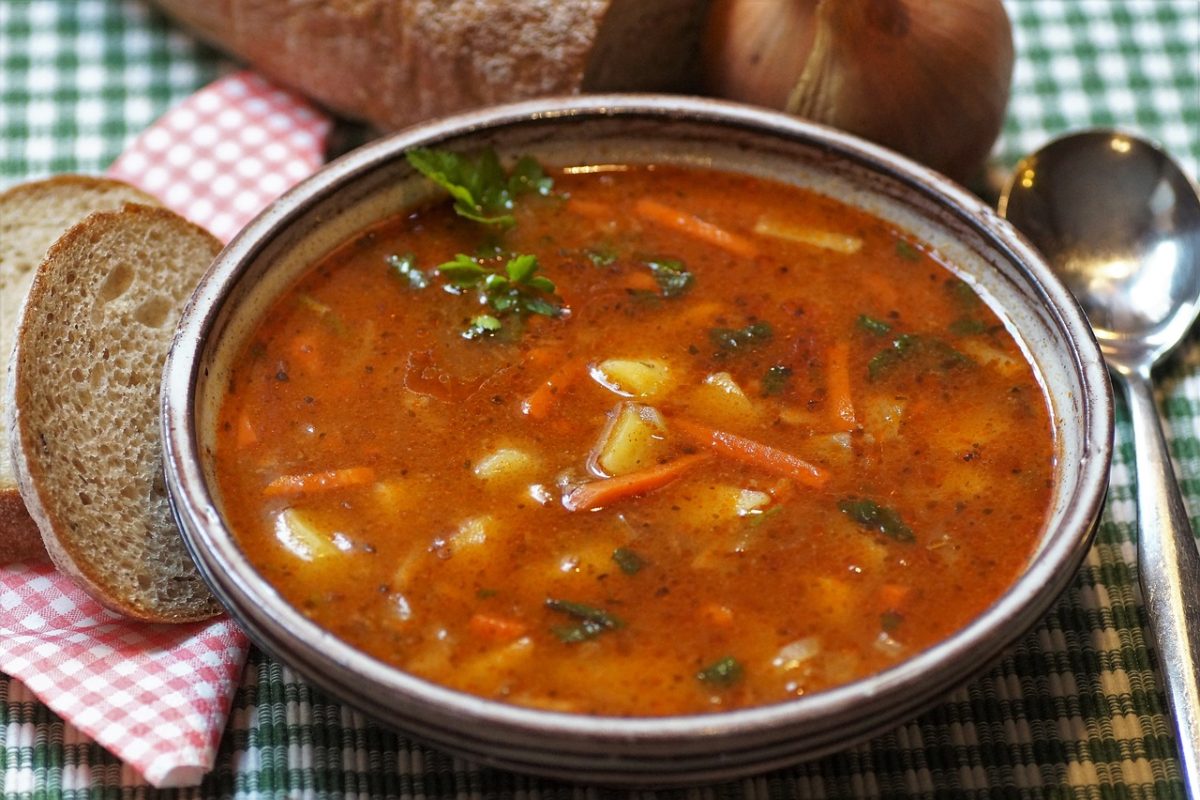
Gundel serves the Goulash soup with homemade noodles, making it unique compared to other restaurants.
Goulash soup in Gundel.
Aszu
For generations, Egri Bikaver (a blended wine from several blue grapes) was the most famous wine produced in Hungary. During communism, it was exported in all directions and was known as a cheap but delicious red wine from Hungary. That has changed, and currently, the most famous wine from Hungary is named Aszu and origins from the Tokaj region. This region is primarily known for its sweet white wine. What better place to combine a traditional Hungarian meal, Gypsy music, and fantastic Hungarian wines than in Aszu?
The restaurant is in a nice area packed with fantastic restaurants; some even have Michelin stars. The restaurant has won several awards and is ideal if you want an upper-class Hungarian dinner in the center of Budapest.
Why not try beef prepared with red wine sauce made from the Bikaver wine? Or the traditional Hungarian stuffed paprika? What about a stuffed pancake as a starter? You will find all this and much more on the menu in Aszu.
Eat a Hungarian dinner on the Danube.
There are different options if you want to eat dinner on the Danube. It is obvious that you don’t eat on the Danube if you are interested in the best ingredients and the most celebrated chefs in Hungary. But if your goal is a nice Hungarian dinner with a magnificent view, you should consider dining on the Danube in a boat traveling up and down the river.
One option is to eat a buffet dinner with traditional Hungarian courses and desserts accompanied by live Gypsy music and Hungarian folk dance. However, a four-course dinner with some laidback live music in the background is a different option. Once again, these might not be the best gastronomical experiences you will have in Budapest, but they are still an excellent way of combining Hungarian food with an extraordinary view.
Eat your Budapest dinner on the Danube while enjoying this view.
Rezkakas
Opposite the Aszu restaurant in a street known for outstanding restaurants, you can find Rezkakas. It is almost identical to Aszu’s style and has more similarities with Aszu than differences. There have been some complaints that service is slow and that it takes a while for the food to be served, but many also praise the quality of the food, the service, and the musicians present in the restaurant every evening.
The restaurant often has tables available for last-minute guests. That makes it a good option if you are looking for a table for tomorrow evening or the upcoming weekend.
Have you been longing to taste Hungarian goose liver? Or an ice cream based in which they use the famous Hungarian sweet Aszu wine from Tokaj? You can taste these and other fantastic dishes in Rezkakas.
Traditional Hungarian dinner in Rezkakas.
Hungarian food with a Michelin star.
Would you like to eat food made by Michelin-awarded chefs in fantastic restaurants? There are some restaurants in Budapest focusing on Hungarian cuisine with Michelin stars. Remember to reserve a table in advance if you want to dine in one of these restaurants.
Stand 25
The most famous chef in Hungary is Tamas Szell. He has participated and performed very well in competitions such as Bocuse d’Or. In addition, he was the chef in the Onyx restaurant, which became the first Hungarian restaurant with a Michelin star during his time as a chef. Since then, Tamas has moved on and is now running the restaurant Stand 25 with Szabina Szullo.
The restaurant quickly received a Michelin star and is one of the finest places in Budapest if you want to eat Hungarian made by the best chefs in the country.
The restaurant isn’t in the center of Budapest, but if you walk across the Chain bridge (the most famous bridge in Budapest) and through the tunnel on the other side, you are suddenly very close to the restaurant.
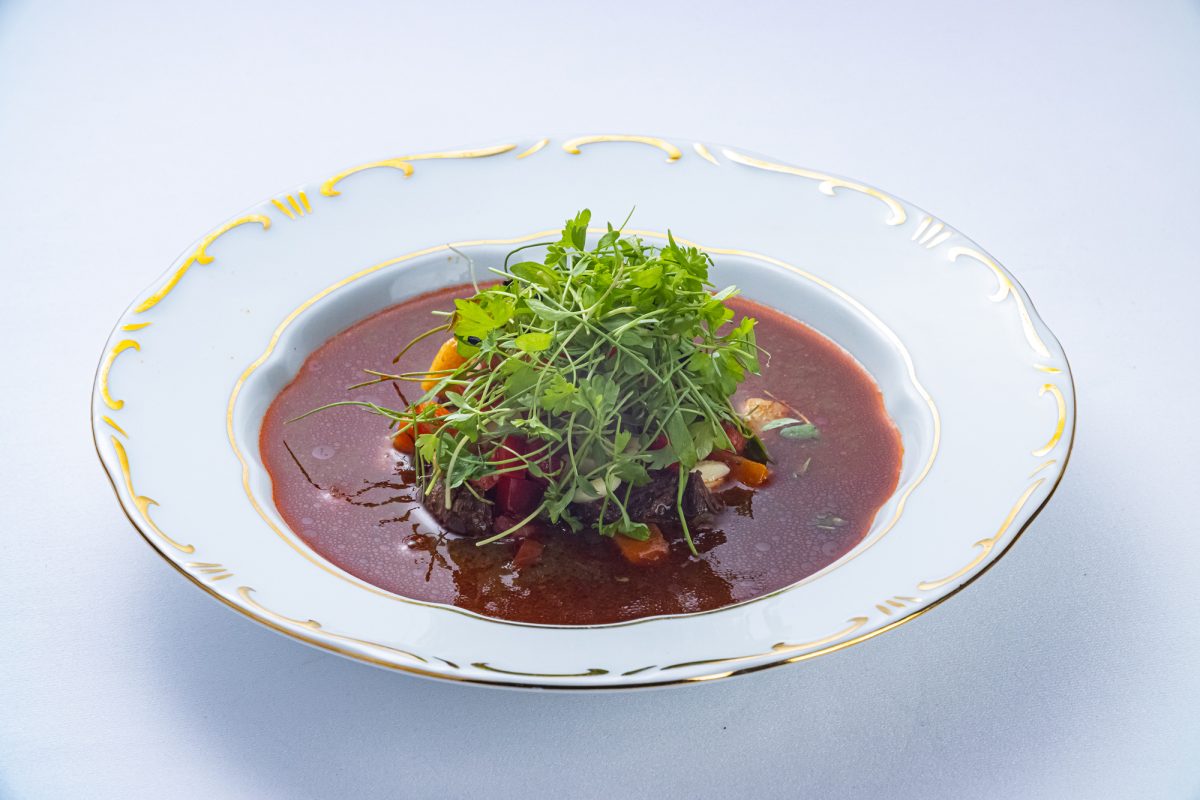
Have you ever wondered what a Michelin-starred Goulash soup tastes like? Or would you instead taste a roasted duck leg with cabbage and potatoes? It might sound easy, but hopefully, you will experience miracles as the food hits your tongue in Stand 25.
Babel
Babel isn’t a restaurant; it is an experience. You don’t order from a standard menu. Instead, you buy a degustation menu consisting of eight courses (or more). Babel is about reinventing traditional Hungarian dishes with modern cooking techniques and presentation. As a result, the degustation menus frequently change according to the season and which fresh ingredients are available.
The restaurant is on the Pest side, close to the Elisabeth bridge. As a result, it is easily accessible for all tourists in Budapest.
What should you taste in Babel? Whatever they serve you!
Salt
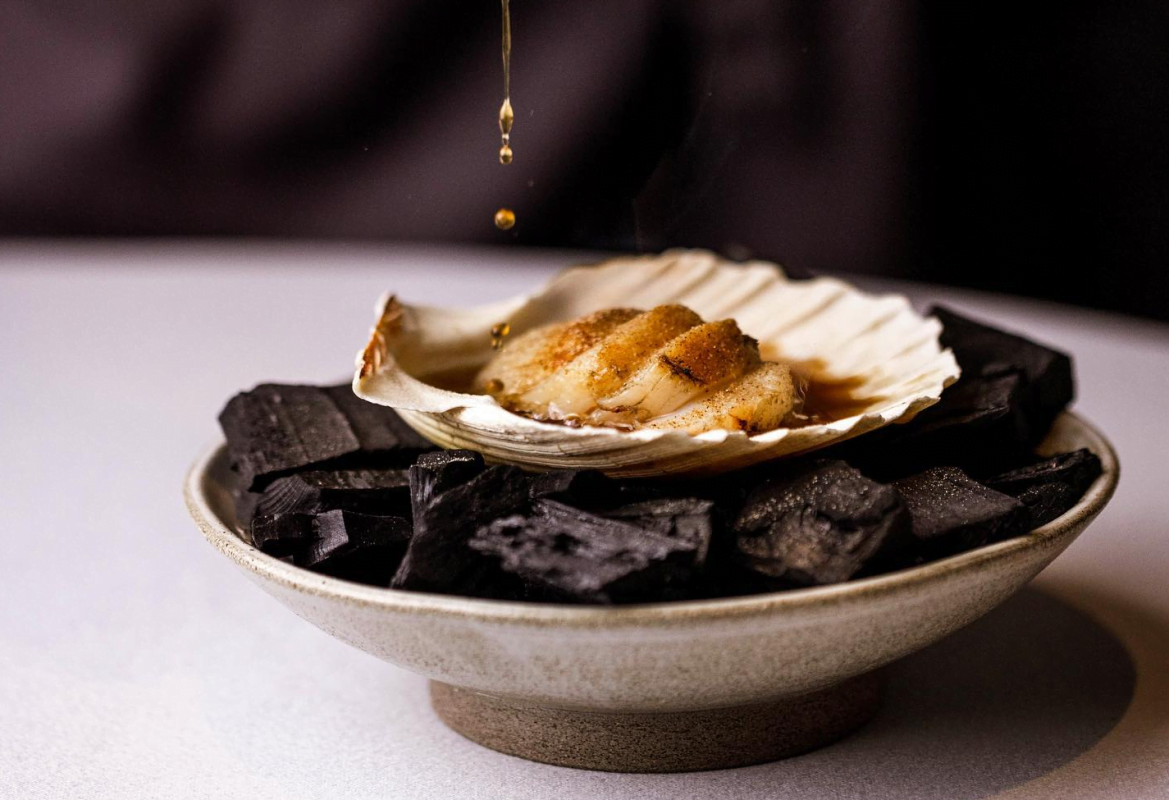
Salt is yet another Michelin-starred restaurant in Budapest, focusing on Hungarian cuisine. Just like in Babel, you buy a degustation menu and eat whatever they bring to the table. The poultry served in the restaurant comes from the chef’s family’s meat manufactury. Besides this, the chef (Szilard Toth) often heads out to the wild to pick wild plants that he uses in the food served in the restaurant.
As you can see in the picture, the dishes might not be gigantic, but they are attractive, local, and tasty!
Other restaurants where you can eat delicious Hungarian food.
If you want to eat Hungarian food in a Michelin restaurant or with Gypsy music in the background, you have already read some suggestions. But would you rather dine in a nice Hungarian restaurant without those extras? Here you have some remaining tips.
Trofea Grill
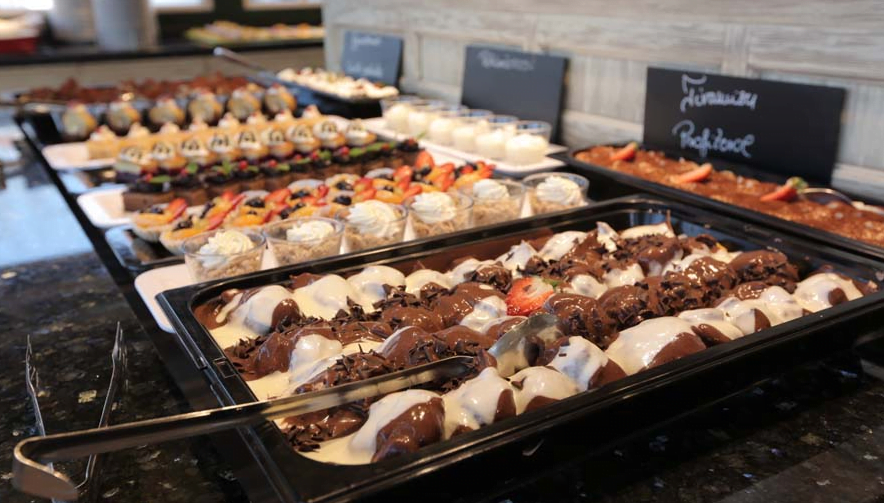
Trofea Grill is a restaurant chain in Budapest with six restaurants in the Hungarian capital. The restaurant operates with a buffet system where you can eat and drink as much as you want for a set price. It might sound primitive, but the quality is surprisingly good. In addition, you can taste a large number of Hungarian dishes during one single meal. You can choose from soups, starters, main dishes, and desserts. The main focus is on Hungarian food, making it easy to get a quick introduction to the local kitchen.
Since you serve yourself, it looks less nice on the plate than in a regular restaurant, but it still tastes incredible!
You can find the most central Trofea Grill restaurant near the State Opera, making it easy to access for everyone.
There are lots of desserts to choose from in Trofea Grill.
Fatal restaurant
Would you like a restaurant serving giant portions and gigantic wiener schnitzels? Then, fatal is the place to go. The restaurant is in Vaci utca, Budapest’s pedestrian street, and it is terrific for Hungarian food the way a grandmother would serve you.
This restaurant is not so much about fine dining. Still, I suspect kids and those hungry will appreciate a dinner in Fatal more than the previously mentioned restaurants in this list.
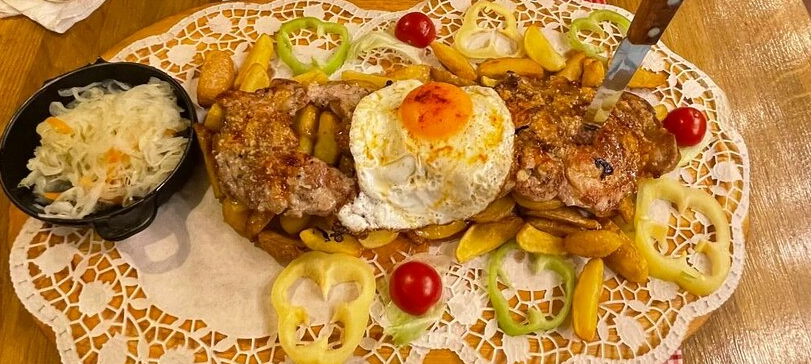
As mentioned, this is the place to visit if you want to eat a 250g wiener schnitzel in Budapest. The menu is extensive, meaning you can choose from a wide selection of starters, soups, main courses, and desserts if you decide to dine in Fatal during your Budapest stay. Throughout the years, celebrities such as Ralph Fiennes, Brian May, Antonio Banderas, and Ferenc Puskas have used this restaurant as the location for their dinners.
What to eat and drink in Hungary?
It is one thing to find a good restaurant and another to know what to order. Here we will briefly introduce some of the most famous and traditional Hungarian courses and drinks.
Traditional Hungarian food worth tasting.
Stuffed cabbage
Stuffed cabbage, also known as “töltött káposzta” in Hungarian, is a traditional dish in many European countries, including Hungary. The dish consists of cooked cabbage leaves filled with a mixture of ground meat (such as pork, beef, or lamb), rice, onions, and various seasonings. The filling is then rolled up in the cabbage leaves, and the rolls are typically braised or baked in a tomato-based sauce.
The exact recipe for stuffed cabbage can vary depending on the region and the family preparing it. Some versions may use different types of meat, while others may include additional ingredients such as paprika, sauerkraut, or bacon.
Goulash soup
Goulash soup, also known as “gulyásleves” in Hungarian, is a traditional soup from Hungary typically made with beef or pork, with lots of onions, paprika, and other vegetables and spices. The soup is flavorful and popular in Hungary and other parts of Central and Eastern Europe. Some people fear the soup’s spiciness, but that isn’t usually a problem.
If you want to spice it up, ask your waiter for some strong paprika and you will quickly feel the heat!
Wiener Schnitzel
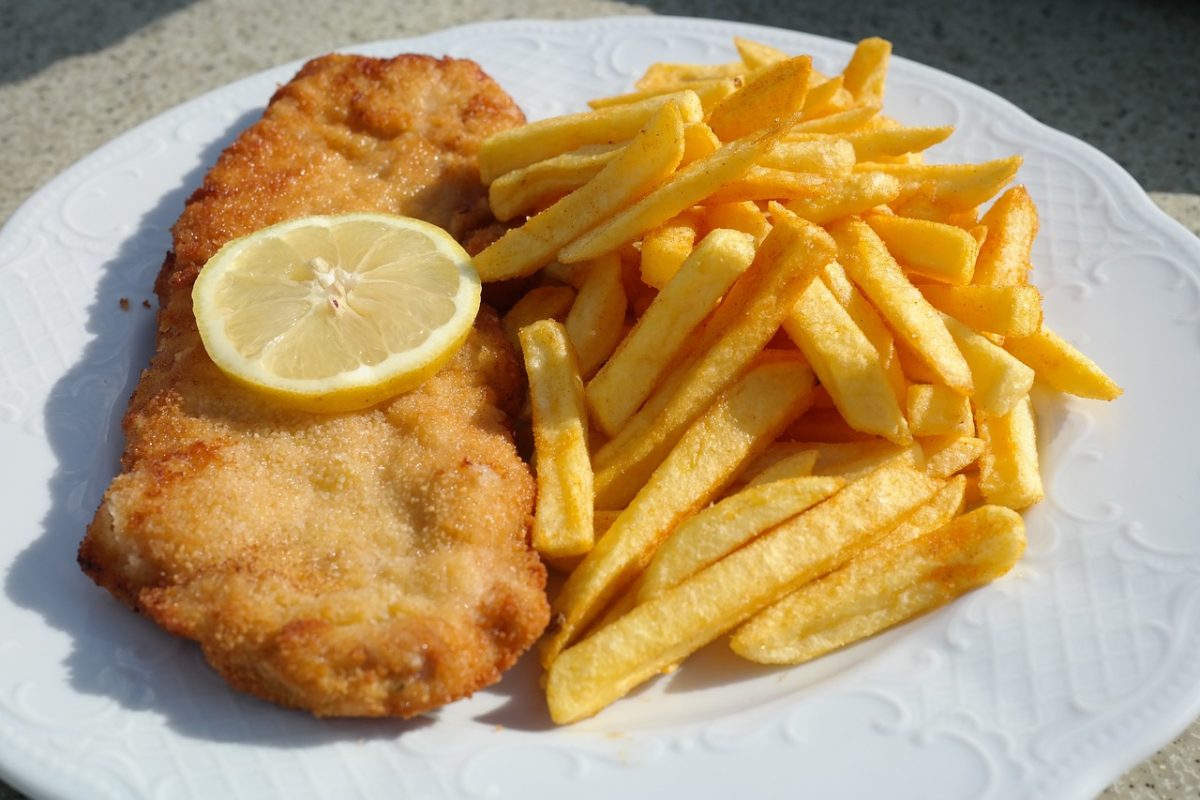
A Wiener Schnitzel is a traditional Austrian/Hungarian dish made from veal, pork, or chicken. It is breaded and fried until it is crispy and golden brown. The dish is often called a “Wiener Schnitzel” because it originated in Vienna, Austria. But since Hungary and Austria have a common history in many ways, the Wiener Schnitzel is considered a Hungarian meal by Hungarians, just like the Austrians consider it Austrian.
To make a Wiener Schnitzel, a thin slice of veal, pork, or chicken is first pounded with a meat tenderizer to make it even thinner and more tender. It is then seasoned with salt and pepper, coated in flour, dipped in beaten eggs, and then coated in breadcrumbs. The breaded veal is then fried in hot oil until it is crispy and golden brown.
Chicken Paprikash
Chicken paprikash, also known as “paprikás csirke” in Hungarian, is a traditional dish from Hungary that features chicken cooked in a paprika-based sauce. This is one of the most popular Hungarian dishes among foreigners, which means you can find it almost everywhere.
The chicken and the sauce are normally served together with homemade noodles, often called “galuska” in Hungarian.
Goose liver
Hungarian cuisine features goose liver as a delicacy and is often served as an appetizer or as part of a larger meal.
Goose liver can be prepared in a variety of ways, including searing, poaching, and pan-frying. One traditional Hungarian preparation is to slice the goose liver into thin pieces and sear it in a hot pan with a bit of oil or butter until it is crispy on the outside and creamy on the inside. The liver is then typically served on a slice of toasted bread or a bed of lettuce with a side of jam or chutney.
Cottage cheese dumplings
Cottage cheese dumplings are a traditional Hungarian sweet dessert made from cottage cheese, flour, eggs, and sugar. The dumplings are formed into small balls, boiled in water, and then served with a variety of sweet toppings.
Gundel pancake
The Gundel pancake, also known as “Gundel palacsinta” in Hungarian, is a famous Hungarian dessert that is named after Károly Gundel, a renowned Hungarian chef and restaurateur. The dessert is a thin pancake filled with a mixture of ground walnuts, raisins, and rum, then covered in a sweet chocolate sauce and flambéed with rum.
It tastes better than it looks!
Somloi galuska
Somlói galuska is a traditional Hungarian dessert that consists of three types of sponge cake layered with vanilla pastry cream, chocolate sauce, and rum-soaked raisins, and topped with whipped cream and caramelized walnuts. The three types of sponge cake used in Somlói galuska are often made from a combination of flour, sugar, eggs, and often ground walnuts or breadcrumbs. The cakes are baked separately and then cut into small pieces or broken into crumbs.
Gesztenyepüré
“Gesztenyepüré” is a Hungarian dessert made from pureed chestnuts, sugar, vanilla, and sometimes rum. The chestnuts are boiled until tender, then peeled and either mashed or pureed into a smooth consistency. Sugar, vanilla, and sometimes rum are added to taste, and the mixture is typically served chilled with a dollop of whipped cream and a drizzle of vanilla sauce on top.
Golden dumplings
Golden dumplings (aranygaluska) is a sweet Hungarian dessert made with sweet yeast dough, butter, sugar, cinnamon, and chopped nuts. The name describes the dessert’s color and shape.
To make aranygaluska, a sweet yeast dough is prepared using flour, yeast, milk, butter, sugar, and eggs. The dough is then divided into small pieces, rolled into balls, and dipped in melted butter before being coated in a mixture of sugar, cinnamon, and chopped nuts, often walnuts.
The balls of dough are then placed in a baking dish and left to rise for a second time before being baked in the oven until golden brown. Once baked, aranygaluska is typically served warm and can be accompanied by a sweet vanilla sauce or a dusting of powdered sugar.
What to drink in Hungary?
Which are the typical Hungarian drinks that you should taste while enjoying your meal in Budapest? Here you have a couple of suggestions.
Palinka (Hungarian fruit spirit)
Palinka is a type of fruit brandy produced in Hungary. It is made by distilling fermented fruit mash, typically from plums, apricots, pears, or cherries.
Palinka is a clear, colorless liquor with a high alcohol content, usually around 40-50% ABV. Most restaurants serve the Palinka as an aperitif or digestif in small glasses. It is worth drinking slowly to fully enjoy the fruit taste.
Wine
Hungary is known for its wine production. In this article, we have already mentioned the sweet white wine from Tokaj and the wine Bikaver from Eger. There is so much to taste as Hungary has 22 wine regions producing wines from all sorts of grapes. In some restaurants, especially the Michelin-starred restaurants, you will often be offered a wine menu specifically made to match the degustation menu.
No matter what you do, taste lots of fantastic Hungarian wine in Budapest.
Unicum
Unicum is a traditional Hungarian herbal liqueur. They make the drink from a secret blend of over 40 herbs and spices. It has a dark brown color and a bitter, slightly sweet flavor with notes of citrus, cinnamon, and clove. Unicum was created in 1790 by a Hungarian physician named Dr. Zwack, who developed the recipe as a medicinal tonic for the royal family.
Over the years, Unicum has become a popular alcoholic beverage in Hungary, often served as a digestif after meals or as a remedy for stomach ailments.
Aszu Budapest is an amazing restaurant. Would you like to reserve a table in Aszu? Would you like to book a table in Aszu Budapest so that everything will be ready for your arrival in the restaurant? Here you can fix your table reservation in Aszu right away.
Aszu is a restaurant in the very heart of Budapest with a very good rumor. There are hundreds of awesome Aszu reviews online, and this is a perfect place to enjoy traditional Hungarian meals prepared by great chefs in nice surroundings. During the evenings, you can also enjoy traditional Hungarian gypsy music in Aszu Budapest.
Reserve a table in Aszu Budapest
Fill in the forms beneath and make sure to select Aszu as the restaurant from the list to reserve a table in restaurant Aszu Budapest.
Once you click the button above, the table reservation request will be sent, and we will come back to you and confirm the table reservation request in 24-48 hours (sometimes much faster).
Where is Aszu located in Budapest?
Restaurant Aszu can be found in Sas street in Budapest. This is located very close to the St. Stephen’s Basilica, close to the Erzsebet square, and there you will also find the Deak square (where three of the metro lines in Budapest meet). This is very central, and it isn’t far from the Danube either. This is a fashionable district in Budapest packed with nice restaurants, and it is a typical area in which you will find banks, lawyers, and many of the wealthy citizens of Budapest. There is no wonder why this area gives a home to several nice restaurants, including the Rezkakas restaurant which is just across the street of Aszu.
Aszu has a nice indoor area, but during nice summer days, you can also sit outside and enjoy your meal. This is very nice, and it can also be a nice experience on a warm spring evening, as they turn on the heaters that will keep you warm, even though the temperature outside might be a bit colder than you normally enjoy.
What does a meal in Aszu cost?
Aszú is positioned in the upper mid-range to fine-dining category, and the prices reflect both the central location near St. Stephen’s Basilica and the high culinary standards. Starters typically range between 4,000 and 7,000 HUF, while main courses generally fall between 8,000 and 14,000 HUF, depending on the ingredients and season.
If you are a fan of Tokaj wines, an excellent choice is the cheese selection, which pairs beautifully with a glass of Tokaji Aszú, the world-famous sweet wine from the Tokaj region. The staff has strong knowledge of Hungarian wines and is happy to recommend pairings, making Aszú an ideal place to combine refined Hungarian cuisine with some of the very best wines the country has to offer.
We might not be TripAdvisor with thousands of reviews, but we would love to hear your thoughts about Aszu. Have you been to the restaurant and want to write a few sentences about your stay? Which was your favorite meal in the restaurant? Did you have a favorite wine? Did you enjoy the gypsy music? Why not use a few minutes to share your thoughts about Aszu Budapest with us, and all of our readers?