
Hungary – Netherlands
Puskas Ferenc Stadium
March 25, 2011 – 14:00
Tickets: WorldTicketShop
Hungary – Netherlands
Puskas Ferenc Stadium
March 25, 2011 – 14:00
Tickets: WorldTicketShop

The Hungarian National Gallery, located in the Castle of Buda, opened a new temporary exhibition June 4th named: “Depero the Futurist and the Impact of Futurism on Avant-Garde Art.” If this sounds interesting, you better head of to the National Gallery where the exhibition is available between June 4th and August 22nd. More information about the exhibition can be found in the press release further down.
Depero the Futurist and the Impact of Futurism on Avant-Garde Art
National Gallery
June 4th – August 22
Press release:
A joint exhibition of the Museo di Arte Moderna e Contemporanea di Trento e Rovereto and the Hungarian National Gallery with the sponsorship and cooperation of the Italian Embassy in Hungary and the Italian Cultural Institute in Budapest, under the Patronage of the Presidents of the Italian Republic and the Republic of Hungary, His Excellency Giorgio Napolitano and His Excellency László Sólyom under the auspices of the Honorable Sandro Bondi, Minister of Cultural Heritage and Activities of the Italian Republic.
The year 2009 marked the 100th anniversary of Futurism, with a number of Futurist exhibitions held in various countries. Over the past twenty years there has been growing interest in the art of versatile Futurist painter Fortunato Depero (1892-1960), an ardent follower of Marinetti’s aesthetics. The over 100 works displayed at the Budapest show are on loan from the Museo Fortunato Depero, Rovereto, an integral part of MART, where the collection of works left by the artist to the town is housed. Living in Austrian-controlled Rovereto until 1918, Depero was in fact raised in a Central European milieu. His artistic development was influenced by Symbolism and Expressionism, and also by the schools of Jugendstil and Wiener Werkstätte. During his trip to Rome he established contact with important Futurist painters such as Boccioni, Balla, Prampolini and Marinetti. His Futurist principles were summarized in the manifesto Ricostruzione futurista dell’universo (Futurist Reconstruction of the Universe), co-authored with Giacomo Balla in 1915, proclaiming the re-creation of the universe and the extension of art to all areas of life. Through his Futurist formal experiments he envisaged mobile sculptured constructions utilising the combined impact of movement and sound effects.
In Rome, after making the acquaintance of Sergei Diaghilev and his Ballets Russes, Depero designed costumes and stage sets for Igor Stravinsky’s Le Chant du Rossignol (The Song of the Nightingale) and for Balli Plastici (Plastic Dances), a picto-plastic drama co-authored with Gilbert Clavel. Between 1916 and 1919, he left off his abstract art experimentations and went on to work towards a new iconography arising from the world of magic and fantasy. Populating his metaphysical and surreal visions with unique shapes brought to life in his pictures, Depero created a kind of meta-reality.
In the autumn of 1919 he opened his studio-workshop called Casa d’Arte Futurista Depero in Rovereto, where, based on his designs, particularly impressive, decorative tapestries, textiles, furniture, toys and graphic design works were produced. In 1929 he founded another Futurist House in New York where he continued his career as a designer. He undertook significant design commissions for the Italian company Campary, the magazines Vanity Fair and Vogue, and Roxy Theater (advertisement and stage sets). He returned to Italy in October 1930. The paintings he did in that period were inpsired by his American experience, featuring urban motifs, skyscrapers, subways, and mechanical parts as visual elements. After the war he lived in the United States for a while again, but received no more commissions. In 1959 he designed and built the first museum of Italian Futurism, the Museo Fortunato Depero which, completely refurbished as one of MART’s venues, was reopened to celebrate the centenary of Futurism. Depero died in 1960. He left all his works to the town of Rovereto.
If you would like to get to know the culture of Java, a nice museum to visit is the Museum of Etnhography in Budapest, next to the Hungarian Parliament. The exhibition is available between June 19 and July 14, so you better hurry up if you are interested.
Examples of Java culture
Museum of Ethnography
June 19 – July 14

Hungary – San Marino
Puskas Stadium
October 8 – 2010, 20:00
Tickets: WorldTicketShop
Visitors to Budapest can now enjoy the exiting exhibition presenting the works of Sass Brunner and Elisabeth Brunner. In 1929 the ladies followed a dream, and set of to India on foot. They reached the land of their dreams and in this exhibition you can see paintings and other works of the two dreamers leaving for India. The exhibition can be seen in the Museum of Applied Arts, the beautiful building by Üllöi Út.
Dreamwalkers in India
Museum of Applied Arts
June 19 – August 22
Hungary – Moldova
September 7th, 2010 – 20.00
Puskas Ferenc Stadium
Tickets: WorldTicketShop
This is the event many have been waiting for since the news was released late 2009. Rod Stewart will perform in Budapest June 26, and the concert is a free event. Thousands of tourists come to Budapest because of this, and several hundred thousand people often visit the parking lot next to the Heroes Square during these annual free concerts. So, this Saturday is the event day, and it should start at 19.00. If you are coming to Budapest for this event, why not book a cheap airport transfer with high quality from us?
More information about the Rod Stewart free concert!
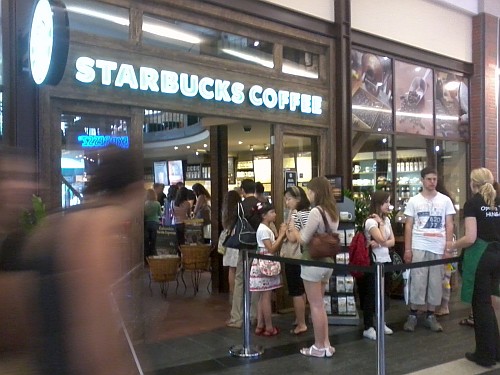
More information about Starbucks at our Starbucks page.

Some people coming to Budapest in these days might ask the question: Where should I watch the World Cup 2010 in Budapest (since we went to Budapest instead of South Africa)? Below you will find a list presenting some different options and opportunities.
Where to watch World Cup 2010 in Budapest
Some restaurants with LCD screens:
Pampas Steakhouse – Table reservation
Fat Mo’s – Table reservation
Friday’s – Table reservation
* if you want a table reservation with a table near an LCD screen, please write in the comment field that you want to watch football
Some places with big outdoor screens:
Holdudvar (Margaret Island)
Corvintető (Corvin Áruház, 4. emelet, VIII. Blaha Lujza tér 1-2)
Liberty Square (big outdoor screen)

Night of Museums is an annual event in Hungary (though it was arranged twice last year – and it seems like it will be this year as well), and it is a very popular event. In the film “Night at the Museum”, featuring Ben Stiller, the museum turns alive after the sunset. That is what will happen in museums all around Hungary this upcoming Saturday as well. There will be special programs in all museums around in the city. You buy one ticket for the entire program, and with this you can enter into all the different museums in the city, and use the public transportation buses travelling between the different locations.
The adult ticket costs 1300 Forint, the ticket for children is 600 Forint.
The event starts at 18.00 and lasts until around 2:30 in the night.
Participating Budapest museums:
‘Zoltan steamer’ non-profit foundation, ‘Debrecen’ ex-‘Kassa’ Danube-sea ship
Ability Park
Endre Ady Memorial Museum
Collection of Veterinary History
Collection of Regional History of Angyalföld (Budapest 13th district)
Aquincum Museum
Bajor Gizi Actors’ Museum
Stamp Museum
Budapest Center for Architect (FUGA)
Budapest University of Technology and Economics-Jendrassik György Laboratory
Budapest University of Technology and Economics-NTICL
Budapest History Museum
Labyrinth of Buda Castle
The Exhibition Hall of the Csekovszky Collection
Museum of Electrotechnics
Eötvös Loránd University, University Library
E10
Erdős Renée Ház – Public Collection and Art Gallery
Ernst Museum
Lutheran Museum
Gallery Eventuell
Ferihegy Aircraft Memorial Park
Underground Railway Museum
Fonó Budai Music Hall
Gallery Lénia
The collection of local history of the XII. th district
Military History Institute and Museum
Holdudvar Gallery
Holocaust Memorial Center
Ferenc Hopp Museum of Eastern Asiatic Arts
Museum of Applied Arts
Kassák Museum
Piety Museum
Museum Kiscell
KOGART House
Liszt Ferenc Memorial Museum
Ludwig Museum – Museum of Contemporary Art
Hungarian House of Photography
Hungarian University of Fine Arts
Hungarian Museum of Trade and Tourism
Museum of Hungrian Agriculture
Hungarian Museum of Science, Technology and Transport
Hungarian National Gallery
Hungarian National Museum
State Archives of Hungary
Hungarian Television Co.
Hungarian Natural History Museum
Hungarian Railway Museum
Hungarian Jewish Museum
Children’s Railway, Budapest
Respect for All – Kossuth Klub
Millenaris
Pál Molnár-C. Studio-Museum
HAS’s Collection of Art
Museum of Music History
Kunsthalle – Budapest
National Dance Theatre
Museum of Ethnography
Museum of Óbuda
Öntödei Múzeum
Hungarian Meteorological Service
National Educational Library and Museum
National Széchényi Library
OSA Archivum/Galeria Centralis (at Central European University)
Pesterzsébet of Museum
Petőfi Literary Museum
Post Museum
The Bartók House of Music in Rákoshegy
Police-history Museum
Semmelweis Museum, Library and Archives of the History of Medicine
SYMBOL Budapest
Szántó Piroska-Vas István Emlékmúzeum
Museum of Fine Arts, Budapest
Hospital in the Rock – Secret Civil Defence Hospital and Nuclear Bunker
Tabán Museum
House of Terror
Tűzraktér Independent Cultural Centre
Museum of the Hungarian Customs and Finance Guard
Vasarely Museum
Former Szikra/Metro Cinema (Ruttkai ÉvaTheatre)
Local History and Schoolmuseum, Pestszentlőrinc (Budapest, XVIII.)
Zwack Unicum Heritage Visitors’ Centre
Event press release:
The eighth Night of Museums, held nation-wide on 19 June, will offer hundreds of programmes and exhibitions to the public.
In keeping with the traditions of major European capitals, Hungary has, since 2003, hosted the Night of Museums on the Saturday closest to Midsummer’s Eve, the longest day of the year. On this day, exhibitions are open after-hours until late at night, and in addition to tours, many other active programmes are available from late afternoon until dawn. A mix of fire juggling, presentations, dance and theatre, special performances, musical events and discussions will be offered nationwide on the Night of Museums.
The first Night of Museums in Hungary only attracted a few thousand people, but by last year, their number had grown to over 380,000 nationwide. This is also the outcome of more and more museums participating each year: a new record will be set this year, with 84 locations available in Budapest and 191 in the country.
Last year, a new tradition was established in the form of the Autumn Night of Museums, which was also well-received by visitors. The initiative was spurred by the huge success of the Night of Museums and by surveys which revelaled that there was public demand for more “Night of Museums” type of events.


